
Case Study: Limehouse Roof Blinds
Turning a complex VELUX product catalogue into a simple online buying experience
Limehouse Roof Blinds
Turning a complex VELUX product catalogue into a simple online buying experience
Client: Limehouse Roof Blinds
Sector: E-Commerce / Home Improvement
Platform: WordPress & WooCommerce
Our Work: Web Design, E-Commerce Development, Custom Product Importer, VELUX Product Configurator, Content & SEO
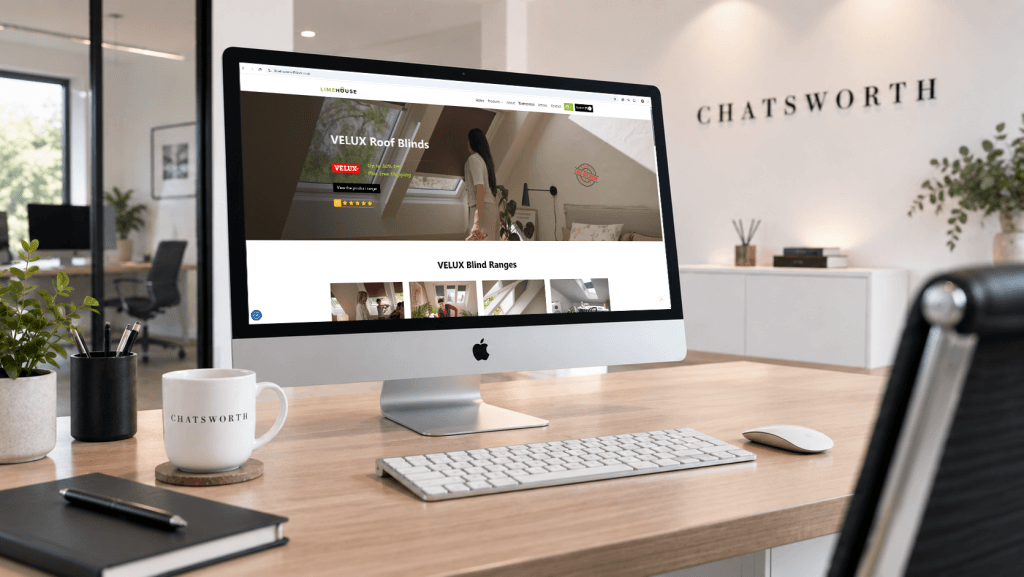
Limehouse Roof Blinds is an authorised VELUX dealer supplying 100% genuine VELUX blinds and accessories to customers throughout the UK.
At first glance, the brief appeared relatively straightforward: create an e-commerce website that would allow customers to buy VELUX blinds online.
The reality was considerably more complicated.
VELUX blinds aren’t simply available in Small, Medium and Large. The correct blind depends upon the model and size of the customer’s existing roof window, while individual products can have further choices including colour, side rail finish and manual, solar or electric operation.
Our challenge was therefore about much more than designing an attractive online shop.
We needed to take a complicated manufacturer product structure and turn it into an e-commerce experience that any homeowner could use with confidence.
The result combines WordPress and WooCommerce with bespoke development, a custom product importer, structured product data and an interactive VELUX blind configurator.
Behind the scenes, the website handles the complexity.
For the customer, choosing the right blind feels simple.
The Project at a Glance
The Challenge
Limehouse needed to sell a technically complex range of genuine VELUX products online. With over 18500 product variations spanning a wide selection of window types, blind types, frame options, blind sizes, operation methods and colour / fabric options there is a huge product range to guide the buyer through.
Customers needed to identify products compatible with their particular roof window without understanding VELUX’s underlying product structure or attempting to measure the window themselves.
At the same time, Limehouse needed a practical way to manage a large catalogue containing numerous relationships between window types, sizes, blind ranges and product options.
Our Approach
We began by understanding the products and the relationships between them before deciding how the website should work.
Rather than simply importing a catalogue and presenting customers with large variation lists, we developed the buying journey around information customers could obtain directly from their existing VELUX window.
We then combined standard WooCommerce functionality with bespoke development to create the specialist functionality the project required.
The Solution
The finished website includes:
- A bespoke WordPress and WooCommerce website
- A custom product importer
- Structured VELUX product and compatibility data
- Product-specific VELUX blind configurators
- Guided window type and size selection
- Manual, solar and electric operation choices where applicable
- Colour and finish configuration
- Detailed product content
- Window identification guidance
- An expanding library of VELUX buying guides and advice
- Search engine optimisation and internal linking throughout the website
The result is an online shop designed around the way customers actually buy VELUX blinds rather than forcing customers to understand the way the manufacturer structures its catalogue.
Early Results
The website is still relatively young and our work to improve its organic visibility is ongoing, so we aren’t interested in dressing early progress up as a finished success story.
What matters is that we’re already beginning to see evidence that the strategy is working.
Our ongoing work has included improving product page content, creating detailed VELUX buying guides and articles, developing the site’s internal linking and targeting relevant organic searches.
Those efforts are beginning to produce sales directly from organic search.
Just as importantly, the bespoke product selection process is doing the job it was designed to do.
So far, we’re not seeing customers order incorrect products through the configurator.
For a website selling products where compatibility is fundamental to the purchase, we consider that as a particularly important measure of success.
- Traffic is useful.
- Rankings are useful.
- Sales are important.
But if the website attracts a customer and then allows them to confidently order the correct product for their particular window, the complete system is doing what we designed it to do.
Behind the Project
The Real Challenge Wasn’t Building an Online Shop
WooCommerce already provides an excellent foundation for selling products online. It can handle products, variations, baskets, payments, customer accounts and orders. The difficult part of this project wasn’t adding an Add to Basket button.
It was answering a much more important question:
How do we help somebody who may know very little about VELUX product codes confidently identify and order a blind that is compatible with the roof window already installed in their home?
That question shaped the entire project.
The website needed to act as a bridge between a technically complicated product catalogue and a homeowner asking a very simple question:
Which blind do I need for my window?
This is an important distinction in the way we approach e-commerce web design.
Sometimes the most important part of an e-commerce project isn’t the checkout.
It’s understanding everything that needs to happen before the customer is confident enough to reach it.
Understanding the Products Before Designing the Solution
Before deciding how the website should present the products, we first needed to understand how those products related to one another.
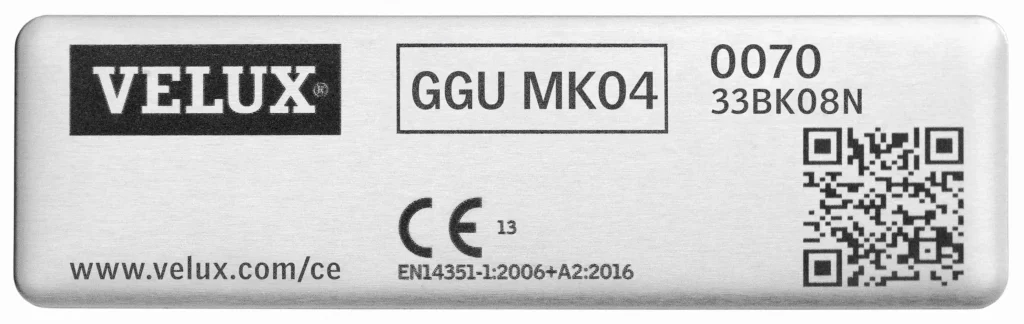
VELUX roof windows carry identification information that can be used to determine the appropriate products.
A typical window identification might include a code such as:
GGL MK04 or GGU CK02
To somebody familiar with VELUX products, those codes contain useful information.
To a homeowner who simply wants a blackout blind for their bedroom, they can initially look like a random collection of letters and numbers.
We didn’t want customers to have to learn the VELUX product catalogue before they could buy from Limehouse.
The website needed to understand the complexity so the customer didn’t have to.
That became one of the fundamental principles behind both the technical development and the customer journey.
No Tape Measure Required
One of the useful characteristics of genuine VELUX products is that customers don’t normally need to measure their roof window to identify the correct blind.
Instead, the required information can be found on the window itself. This gave us a much better starting point for the buying process.
Rather than asking customers to measure glass, frames or window openings and then compare those measurements with complicated size tables, we could build the process around the existing VELUX identification code.
The website explains how to locate it.
The customer simply opens the roof window, finds the identification plate on the top edge of the sash and notes the relevant model and size information. That information can then be used when configuring the blind.
This removes several opportunities for error. There is no uncertainty about which part of the window should be measured. There is no need to convert dimensions. There is no question about whether a few millimetres matter.
And there is far less risk of a customer ordering a product based upon an inaccurate measurement.
The solution wasn’t to make measuring easier. It was to remove measuring from the process altogether.
Turning Manufacturer Information Into E-Commerce Data
Before customers could use the website effectively, we also needed the right product structure behind it.
Large manufacturer catalogues often contain all the information a retailer requires, but rarely in exactly the structure an e-commerce platform would ideally like to receive it.
Product information can involve relationships between:
- Product families
- Product codes
- Window types
- Window sizes
- Blind types
- Operating methods
- Colours
- Rail finishes
- Compatibility
- Prices
- SKUs
- Variations
- Descriptions
- Images
Trying to recreate a complicated catalogue manually inside WooCommerce would be inefficient and would introduce unnecessary opportunities for human error. So we treated this as a data problem rather than a product-entry exercise.
Developing a Bespoke WooCommerce Product Importer
We developed a custom importer to help transform the supplied product information into structured WooCommerce data.
This is one of the reasons we use WordPress and WooCommerce for projects that may require bespoke functionality.
- WordPress provides a mature content management system.
- WooCommerce provides an established e-commerce framework.
But neither prevents us from developing functionality around the particular requirements of a project.
For Limehouse, we could therefore use WooCommerce for the standard components of an online shop while developing our own solution for the specialist parts of selling VELUX blinds.
The importer allowed the underlying product information to be processed systematically rather than relying upon repetitive manual product creation.
That doesn’t just save administrative time. It also creates consistency.
When there are large numbers of relationships between products, window codes and available options, reducing unnecessary manual data entry also reduces the opportunity for mistakes.
When a Product Variation Isn’t Just a Variation
On a simple online shop, a product might look like this:
Product: T-shirt
Size: Large
Colour: Blue
Price: £25
The choices are largely independent.
VELUX products are different because one choice can determine which later choices are valid.
The customer’s window determines which blind configurations are compatible. The blind range can determine which operation methods are available. The operation method can affect the product variant. Different products can offer different colours, finishes and options.
Not every theoretical combination should therefore be presented to the customer.
This is an important difference between simply displaying variations and actually understanding compatibility.
A standard dropdown can show a list of options, however the Limehouse website needed to guide the customer towards a valid product.
Building the VELUX Blind Configurator
The most visible piece of bespoke development is the product configurator.
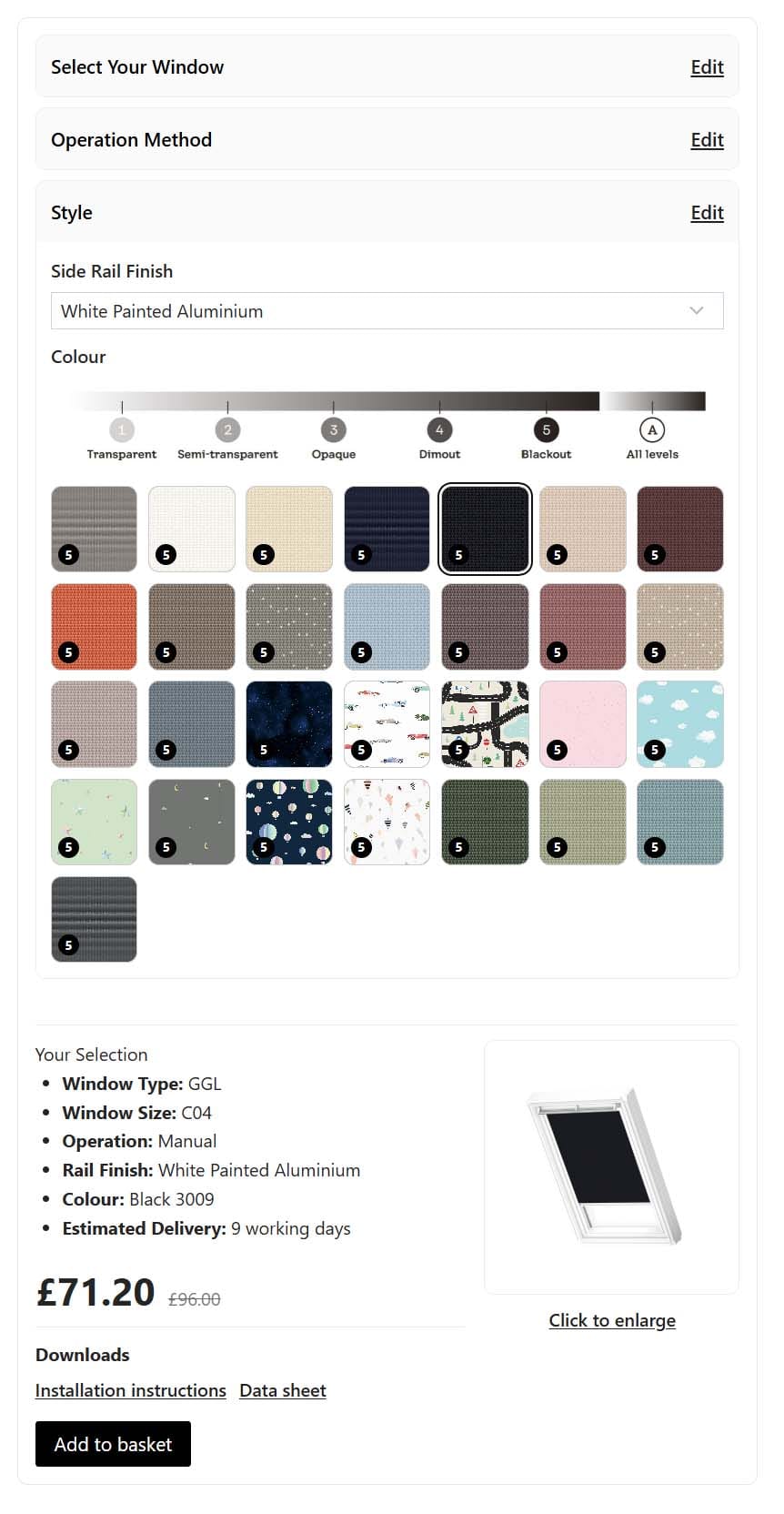
Instead of confronting customers with a huge collection of product codes and variations, we divided configuration into a series of logical decisions.
1. Identify the Window
The customer selects the relevant VELUX window type and size.
For example, they might identify their window as a GGL with an MK04 size code.
This establishes the fundamental compatibility information required to configure the blind they are viewing.
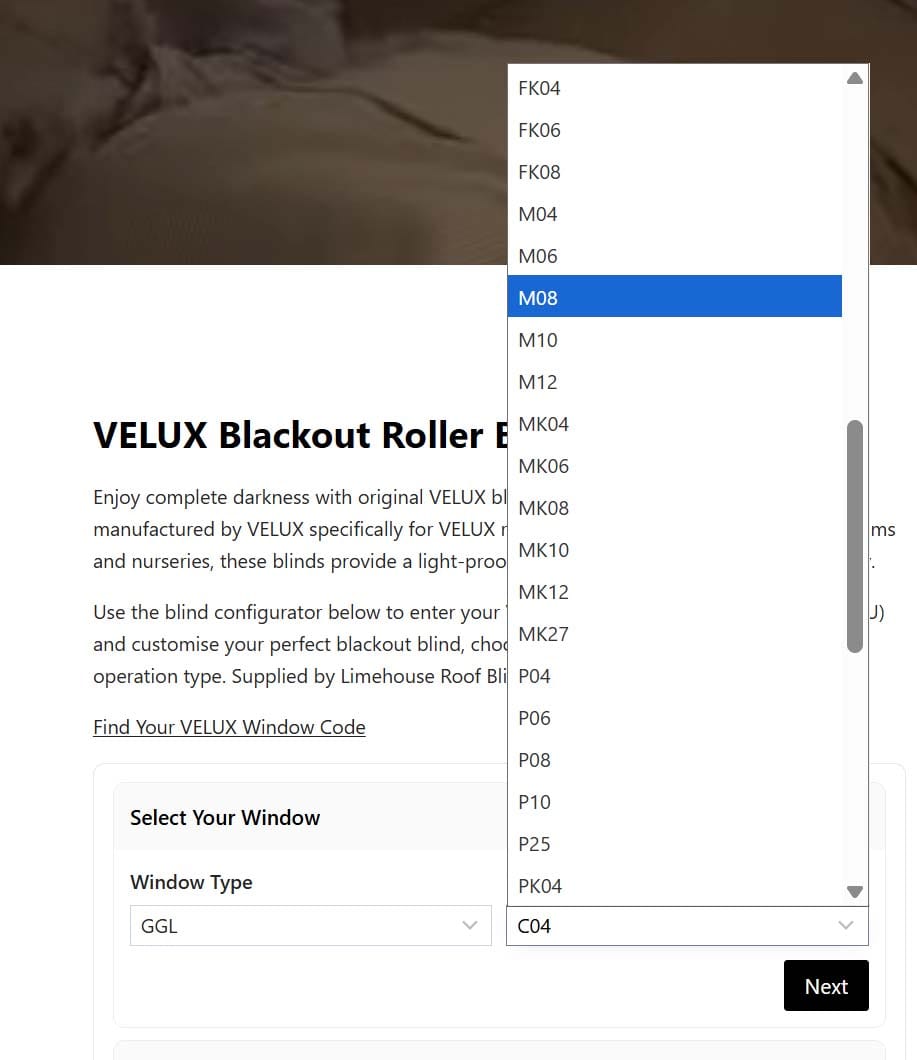
The Blind configurator tool takes the entire database of VELUX blinds and filters them using your blind type, Window Type and Then Size Code ensuring the correct blind is delivered every time.
2. Choose How the Blind Operates
Where a product supports different operation methods, customers can select the appropriate option.
Depending upon the particular blind, this can include:
- Manual
- Solar
- Electric
The website can also provide relevant information about those choices. For example, electric products may require an appropriate electric VELUX window.
This is information that could easily be missed if the website simply displayed another dropdown without explaining what the choice means.
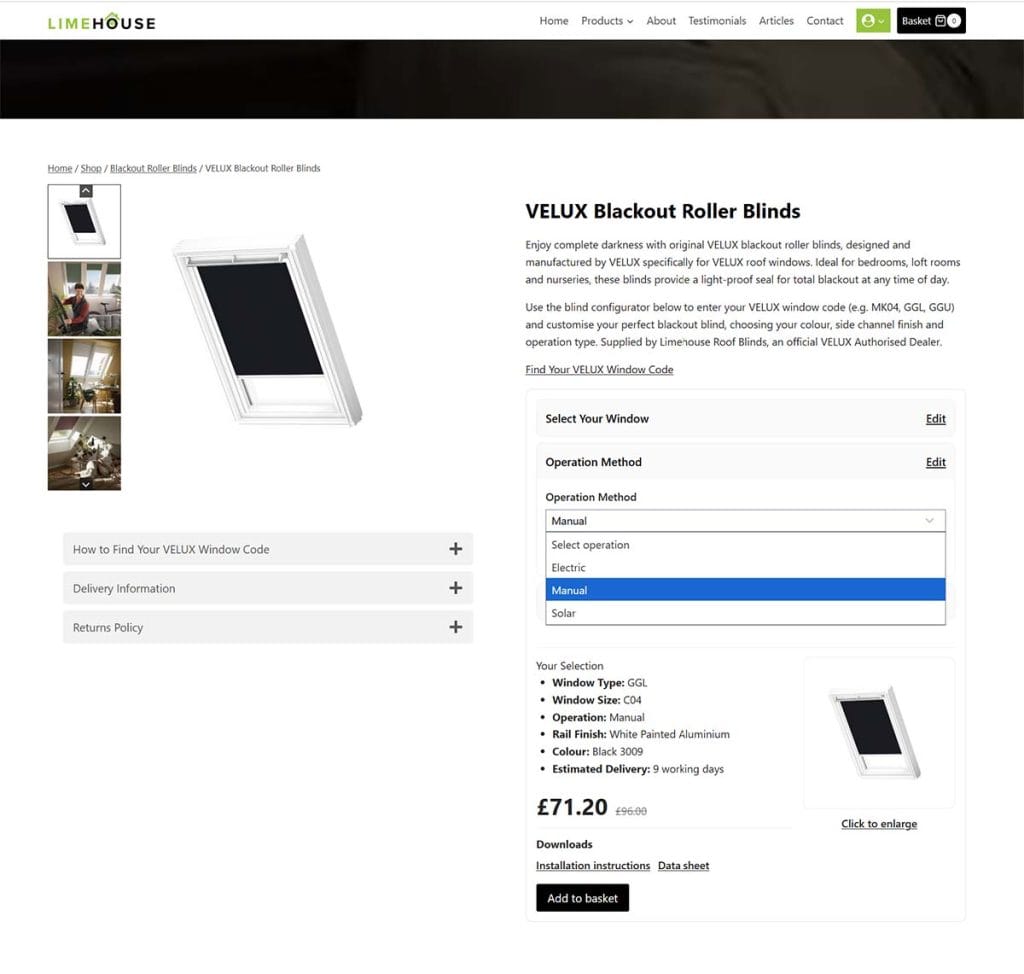
3. Choose the Style
Once the technical decisions have been made, the customer can move on to the aesthetic choices.
Depending upon the product, these can include:
- Side rail finish
- Blind colour
- Other product-specific options
The order is deliberate.
We establish what will work before asking the customer what they would like it to look like.
Making Complexity Almost Invisible
There is quite a lot happening behind that process, but the customer shouldn’t need to think about it. From their perspective, the website is asking a small number of understandable questions:
- Which window do you have?
- How would you like the blind to operate?
- Which finish would you prefer?
The complexity belongs to the website, not to the customer. Websites that make both finding and purchasing products easy have much higher conversion rates than complicated catalogues.
That’s a principle that extends well beyond this particular project.
A good e-commerce website shouldn’t merely make products available to purchase.
It should make those products easier to buy.
Keeping the Configurator Relevant to the Product
The Limehouse configurator works in the context of the product the customer is viewing.
If somebody is looking at a VELUX Blackout Roller Blind, the configurator helps them select the appropriate Blackout Roller Blind for their window.
If they’re looking at an anti-heat product, they’re presented with the choices relevant to that product.
It isn’t simply a site-wide catalogue search displaying every possible VELUX product. The options the customer is presented with are always relevant to their selections. They will never get to the end of the options to find out that their choice of blind is not available.
This keeps the buying journey focused. By the time somebody reaches a product page, they may already have decided what type of blind they want.
Our job at that stage is to help them purchase the correct version, not send them back to the beginning of the catalogue.
What Happens If the Customer Gets Stuck?
Guided buying systems work well when customers have the information you’re asking for. But good usability also means considering what happens when they don’t.
The website therefore includes clear instructions showing customers where to find their VELUX window code.
Typical examples such as GGL MK04, GGU CK02 and GPL FK06 help make the instructions more tangible.
And if the identification plate is worn, unclear or the customer simply isn’t sure what they’re looking at, Limehouse encourages them to take a photograph and get in touch for help.
It’s a relatively small part of the website, but an important part of the thinking behind it.
- We don’t assume every visitor will follow the perfect journey.
- We provide somewhere for them to go when they can’t.
Reducing Uncertainty Before Checkout
Confidence matters enormously when purchasing a technical product online.
A customer might like the product, accept the price and be perfectly happy with the delivery arrangements, but still abandon the purchase because of one unanswered question:
What if I’ve ordered the wrong one?
That means reassurance has to be more than a generic collection of trust badges beside the checkout.
For Limehouse, confidence comes from the whole purchasing experience:
- The site explains the window coding system.
- The configurator guides the customer through the available options.
- Product pages give detailed product descriptions and what they’re suitable for.
The website clearly identifies Limehouse Roof Blinds as an authorised VELUX dealer.
And the content reinforces that customers are purchasing 100% genuine VELUX products designed for VELUX roof windows.
Each of those elements removes a different source of uncertainty.
Is the Configurator Working?
This is where we can now move beyond explaining what we hoped the configurator would achieve and look at what is actually happening.
Since customers have started using the website to place orders, we haven’t been seeing incorrect products being purchased through the configurator.
For us, that’s significant.
The purpose of the system was never simply to create an impressive-looking product selector. It was designed to reduce the risk of customers choosing a blind that wasn’t appropriate for their VELUX window.
Every correctly configured order provides evidence that the process is doing its job. It also has a potential benefit beyond the initial online sale.
An incorrect product can create a poor customer experience, additional customer-service work and the cost and administration associated with resolving the problem.
Helping customers get the decision right before they add the product to their basket is better for everybody.
Different Products Need Different Stories
Another part of the project involved moving away from treating the catalogue as a collection of near-identical blinds.
Customers don’t necessarily begin their search even knowing a product name. But they have a problem to solve
- They want a bedroom to be darker.
- They want privacy without losing daylight.
- They want better insulation.
- They want more control over sunlight.
- Or they have a loft room that becomes uncomfortably hot during summer.
The website content therefore needs to explain why somebody might choose one type of VELUX blind rather than another.
Blackout products can suit bedrooms and children’s rooms where controlling light is particularly important.
Translucent products can soften incoming daylight while retaining a brighter room.
Energy pleated products can combine blackout performance with additional insulation.
Venetian blinds provide adjustable light control and can be suitable for rooms such as kitchens and bathrooms.
Exterior anti-heat products tackle solar heat before it passes through the roof window.
That information helps search engines understand the products, but its primary purpose is much simpler:
It helps customers make a decision.
Content Became Part of the Product Experience
This is why we don’t see design, development and content as completely separate stages of a project.
A technically excellent configurator isn’t particularly useful if customers don’t understand what they’re configuring.
Likewise, beautifully written product descriptions can’t compensate for a purchasing interface that makes selecting the correct product unnecessarily difficult.
For Limehouse, we developed the supporting content alongside the functionality.
That includes product information, selection guidance, window-code explanations, product comparisons and supporting articles.
The objective is to answer questions at the point customers are likely to ask them.
Building a Useful VELUX Knowledge Base
The website has subsequently developed beyond its core commercial product pages.
Limehouse now has an expanding collection of detailed guides covering subjects such as:
- How to choose the right VELUX blind size
- Manual vs electric vs solar VELUX blinds
- Why choose genuine VELUX blinds?
- Which VELUX blind is right for you?
- The best VELUX blinds for different rooms
- Common mistakes when buying VELUX blinds
- Whether genuine VELUX blinds are worth the investment
- Choosing blinds for children’s rooms
- General VELUX blind buying advice
These articles aren’t there simply because somebody told us that websites should have a blog.
They answer genuine questions that arise during the buying process.
They also give us useful destinations for internal links from products and categories, provide search engines with more context about Limehouse’s specialist subject and allow the company to demonstrate its knowledge beyond simply listing products and prices.
SEO That is Starting to Produce Customers
Our SEO work on Limehouse is ongoing.
We have been developing the product pages, improving the supporting content, publishing useful articles and strengthening the internal relationships between the informational and commercial parts of the website.
It’s still early enough that we wouldn’t present the website as a completed SEO success story. But we are already seeing something much more useful than an arbitrary improvement in a visibility score:
Customers are finding Limehouse through organic search and placing orders. That’s the outcome we’re ultimately interested in.
Rankings matter because they create visibility. Traffic matters because it brings potential customers to the website. But neither is the commercial objective.
The objective is to bring relevant people to the website and give them enough information and confidence to become customers.
Seeing organic visitors progress all the way from a Google search to a completed order is an encouraging early indication that the combination of technical SEO, useful content, product optimisation and the buying experience is beginning to work as intended.
SEO That Supports the Customer Journey
This is also why our approach isn’t simply to optimise a collection of product pages and wait.
An e-commerce website can easily become dominated by product names, manufacturer descriptions, categories and variations.
Customers, however, don’t exclusively search for products.
They also search for answers.
A potential Limehouse customer might ask:
- Which VELUX blind do I need?
- How do I find my VELUX window code?
- Do I need to measure for a VELUX blind?
- Which VELUX blind is best for a bedroom?
- Should I choose manual, solar or electric?
- How can I reduce heat through a VELUX roof window?
These searches can happen considerably earlier in the buying journey.
By creating useful content around those questions, Limehouse can help potential customers before they’re ready to choose a particular product.
The advice content then connects naturally with relevant categories and products through internal links. For us, this is where content, usability and SEO begin to overlap.
The objective isn’t simply to generate traffic. It’s to attract people with a relevant problem and help them move towards the appropriate solution.
Why WordPress and WooCommerce Worked for This Project
Limehouse Roof Blinds was developed using WordPress and WooCommerce.
One reason we continue to use WordPress is that it gives us a strong foundation without restricting every project to off-the-shelf functionality.
For a straightforward website, WordPress provides an excellent content management platform.
For an online retailer, WooCommerce adds the established shopping functionality.
And when a business has a specialist requirement, we can build around it.
For Limehouse, that meant combining familiar WooCommerce functionality with custom development for the product data and configuration process.
You can read more about our approach to WordPress website design and development.
Why We Didn’t Try to Solve Everything With Plugins
There is a WordPress plugin for almost everything. That doesn’t mean another plugin is always the right answer.
For specialist projects, combining several general-purpose plugins can sometimes create more complexity rather than less.
Worse still, the business can end up changing the way it works to accommodate the limitations of the software.
We already understood the problem Limehouse needed to solve. We understood the relationships between the products. And we knew what we wanted the customer journey to look like.
Bespoke development allowed us to build around those requirements rather than forcing a generic product configurator to behave like a VELUX-specific system.
That’s an important distinction in the way we approach WordPress development.
We use existing technology where it does the job well.
We develop something ourselves when there’s a good reason to.
Designing for Change
An e-commerce website also needs to survive beyond launch day.
- Product catalogues change.
- Manufacturers introduce new products.
- Colours and options change.
- Prices are updated.
- Older ranges disappear.
- New variations are introduced.
This made the underlying structure and importer particularly important.
A website that works beautifully when it launches but requires hours of manual development whenever the product catalogue changes can quickly become expensive and frustrating to maintain.
By approaching the product information systematically, we created a much stronger foundation for the store to continue developing.
Testing More Than Pages
Custom e-commerce development also changes what testing means.
On a brochure website, much of the testing is concerned with content, layout, forms, devices and browsers.
- An interactive e-commerce system adds another layer.
- We need to consider what happens as customers make different selections.
- Are the appropriate window choices available?
- Do later options respond correctly to earlier decisions?
- Does the configured product carry through correctly into the purchasing process?
- Is the interface understandable on a phone?
- What happens if somebody doesn’t know their window code?
- Can they find help without abandoning the purchase?
An e-commerce website isn’t simply a collection of pages. It’s a system. We need to test the journey, not just the design.
Making a Complex Configurator Work on Mobile
This is particularly important on smaller screens.
It would be relatively easy to display a huge table of VELUX codes and options on a desktop monitor. It would also be a terrible customer experience on a phone.
Breaking the configuration process into logical stages allows the interface to remain manageable on smaller devices.
Instead of presenting every possible choice simultaneously, the website asks for information progressively.
That reduces visual clutter and makes the process easier to understand.
The principle is simple: Ask for information when it’s needed, not all at once.
The Finished Website
The finished Limehouse Roof Blinds website does considerably more than display products.
It translates a specialist manufacturer’s product structure into a buying process designed for consumers.
Behind the scenes, the website handles structured product data, compatibility information, WooCommerce products and bespoke logic.
From the customer’s perspective, the process is much simpler:
- Identify the window.
- Choose the blind.
- Configure the available options.
- Place the order.
And we can now add two important pieces to that story:
Customers are successfully using the configurator to order the correct products.
Organic search is beginning to generate sales.
Those are early results, but they’re meaningful ones because they relate directly to the problems the website was designed to solve.
Launch Wasn’t the End of the Project
The website has continued to develop since launch.
- Product content has expanded.
- Buying information has improved.
- New relevant articles have been created.
- Internal linking has developed.
- Selection guidance has become more detailed.
And our SEO work continues as we learn more about how customers search for, compare and purchase VELUX products.
The early organic sales are encouraging, but we see them as the beginning rather than the end of that process.
This reflects our wider approach to web design.
We don’t see a website as a brochure that is completed, published and forgotten.
It should provide a platform that can continue to develop alongside the business.
What the Limehouse Project Demonstrates
We particularly like this project because it brings together so many different aspects of our work.
- We designed and built the website.
- We developed it using WordPress and WooCommerce.
- We worked through a complicated product catalogue and the relationships within it.
- We developed custom functionality to import and structure product information.
- We built the product configurator.
- We planned the customer journey.
- We wrote and developed product and supporting content.
- We considered organic search throughout the structure of the website.
We have continued working on the site after launch and can now see evidence that those individual pieces are working together.
Customers are finding the website through organic search and placing orders. The product configurator is guiding customers towards compatible products.
The informational content is supporting the commercial website rather than existing as a disconnected blog.
But the most important part happened before any of those things.
We understood the problem.
The custom development solves that problem.
The configurator is useful because it solves that problem.
The importer is useful because it solves that problem.
The content and SEO are useful because they help the right customers find the solution.
Technology should support what a business and its customers are trying to achieve.
Not the other way around.
Do You Have an E-Commerce Project That Doesn’t Fit an Off-the-Shelf Solution?
Not every online shop fits neatly into a standard template.
You may have hundreds of product variations.
Compatibility might depend upon information supplied by the customer.
Your manufacturer or supplier data might not translate neatly into WooCommerce.
Customers may need help choosing between technically similar products.
Or perhaps you’re already running an online shop but spending far too much time manually managing something that could be automated.
These are the kinds of projects we enjoy.
At Chatsworth, our e-commerce web design combines established platforms such as WooCommerce with bespoke development where a project genuinely requires it.
Our wider web design service covers planning, design, development, content, testing, launch and ongoing support.
And if WordPress is the right platform for your project, our WordPress website design and development isn’t limited to installing a theme and a collection of plugins.
You don’t need to come to us with all the answers.
You don’t need to know which plugin you need, how the code should work or even whether the idea you have in mind is possible.
Just tell us what you’re trying to achieve, what’s getting in the way and what you’d like your website to do better for your business.
We’ll listen, ask the right questions and work through the possibilities with you. Sometimes the answer is straightforward. Sometimes it takes a little more thought, research and development.
That’s the part we enjoy.
If you have an e-commerce project that feels complicated, unusual or simply doesn’t seem to fit an off-the-shelf solution, we’d genuinely like to hear about it.
Working out how to solve it is our job.