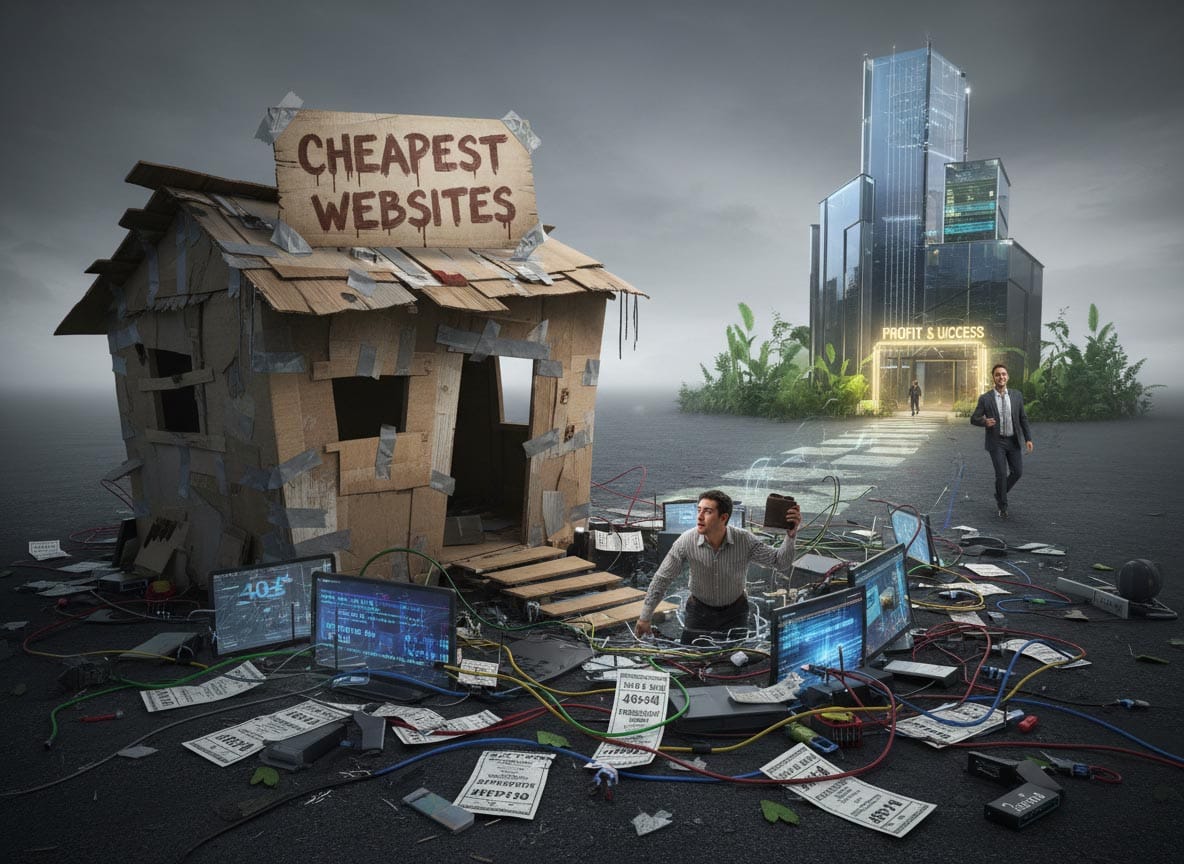
Why Cheap Websites End Up Costing More in the Long Run
Choosing a web design provider often comes down to cost. For many businesses, especially smaller or growing ones, a cheap website can feel like a sensible way to get online quickly without committing too much budget.
There is nothing wrong with being cost-conscious. Problems arise when the long-term implications of a cheap website are not fully understood. In practice, the lowest upfront price often leads to higher costs later on — just in less obvious ways.
This article explains why cheap websites frequently end up costing more over time, and how to think about website investment more realistically.
The Appeal of a Cheap Website
Cheap websites are tempting for understandable reasons:
- budgets are tight
- a website feels like a starting point, not a priority
- many providers promise fast turnaround
- it’s hard to judge quality at the beginning
When the goal is simply to “have something online”, a low price can seem like the sensible choice.
What “Cheap” Usually Means in Practice
In most cases, a cheap website involves compromises somewhere in the process.
These often include:
- little or no time spent understanding the business
- minimal planning or structure
- generic templates reused many times
- rushed or placeholder content
- limited consideration of how customers actually find the site
None of these issues are always obvious at launch. They tend to surface later, once the website is expected to start pulling its weight.
Hidden Cost 1: Rebuilding Sooner Than Expected
One of the most common outcomes of a cheap website is that it is quickly outgrown.
As the business evolves, the website struggles to:
- support new services
- attract better-quality enquiries
- rank for relevant searches
- present the business professionally
At this point, a rebuild becomes unavoidable. What initially looked like a saving often turns into paying twice.
This is where properly planned web design makes a difference, because it focuses on long-term structure rather than short-term delivery.
Hidden Cost 2: Poor Visibility and Missed Opportunities
Many low-cost websites are built without any real consideration of how customers search or decide.
The result is often:
- pages that exist but never get found
- content that doesn’t match customer intent
- visitors arriving but not enquiring
The cost here is not technical — it’s lost opportunity. If the right people never find the site, or don’t feel confident enough to act, potential business is quietly slipping away.
A Common Scenario We See in Practice
A typical situation we see involves a business being quoted around £5,000 for a professionally planned website. This usually includes time spent understanding the business, its customers, how people search for the service, and how the site should guide visitors towards making contact.
Instead, the business chooses a much cheaper option. A friend or acquaintance builds a small website with a couple of pages and some rushed content. On paper, the business saves several thousand pounds in development costs.
The problem appears later.
The website does not rank well for relevant searches. It does not clearly explain the value of the service. When potential customers land on the site, it doesn’t inspire confidence or encourage them to get in touch.
Even if only a small number of genuine enquiries are lost each month as a result, the cost of missed sales can quickly outweigh the original saving. Over a year or two, the revenue lost often exceeds what a properly planned website would have cost in the first place.
This is why the cheapest option is rarely the most cost-effective one.
Hidden Cost 3: Lost Time and Ongoing Frustration
Another overlooked cost is time.
Business owners often end up:
- constantly tweaking the site themselves
- struggling to make changes
- chasing someone unavailable for support
- working around limitations instead of solving them
Time spent fighting with a website is time not spent running the business.
Hidden Cost 4: Paying to Fix Problems That Shouldn’t Exist
Cheap websites frequently require paid fixes later on.
These might include:
- improving structure
- rewriting content
- addressing technical limitations
- rebuilding sections that were rushed
Fixing a weak foundation is rarely efficient. In many cases, the money spent patching problems could have gone towards doing things properly from the start.
When a Cheap Website Can Make Sense
Cheap websites are not always the wrong choice.
They can be appropriate for:
- early-stage ventures
- temporary projects
- proof-of-concept ideas
- internal or low-risk uses
Problems arise when expectations don’t match reality — when a low-cost website is expected to perform like a strategically planned one.
Cheap vs Cost-Effective: The Important Difference
There is a big difference between something being cheap and something being cost-effective.
A cost-effective website:
- is designed around real business goals
- considers how customers search and decide
- is structured to grow with the business
- costs less over its full lifespan
Upfront price is only one part of the equation.
Our Perspective After Decades of Web Design
We have been designing and supporting business websites since 1996, and over that time we have rebuilt many sites that started as low-cost solutions.
The pattern is consistent. When planning, structure, and intent are overlooked at the beginning, the cost almost always shows up later — either in lost opportunities, wasted time, or full rebuilds.
Experience has shown us that long-term thinking usually saves money, not the other way around.
How to Decide What’s Right for Your Business
Before choosing a website option, it’s worth asking:
- how important the website is to enquiries or sales
- how long you expect it to last
- how competitive your market is
- how much time you can realistically invest
- what growth looks like for your business
Answering these honestly often makes the right choice much clearer.
Final Thoughts
Cheap websites are not inherently bad. They become expensive when they are expected to deliver results they were never designed to support.
Understanding the difference between upfront cost and long-term value is key. In many cases, spending a little more at the start avoids far greater costs later on.
If you are weighing up your options and unsure which route makes sense for your business, a short conversation can often help clarify the most sensible next step.
You can get in touch to talk through your situation without pressure or obligation.